
Schools in Cyprus: A Newcomer Parent’s Honest Guide (2026)
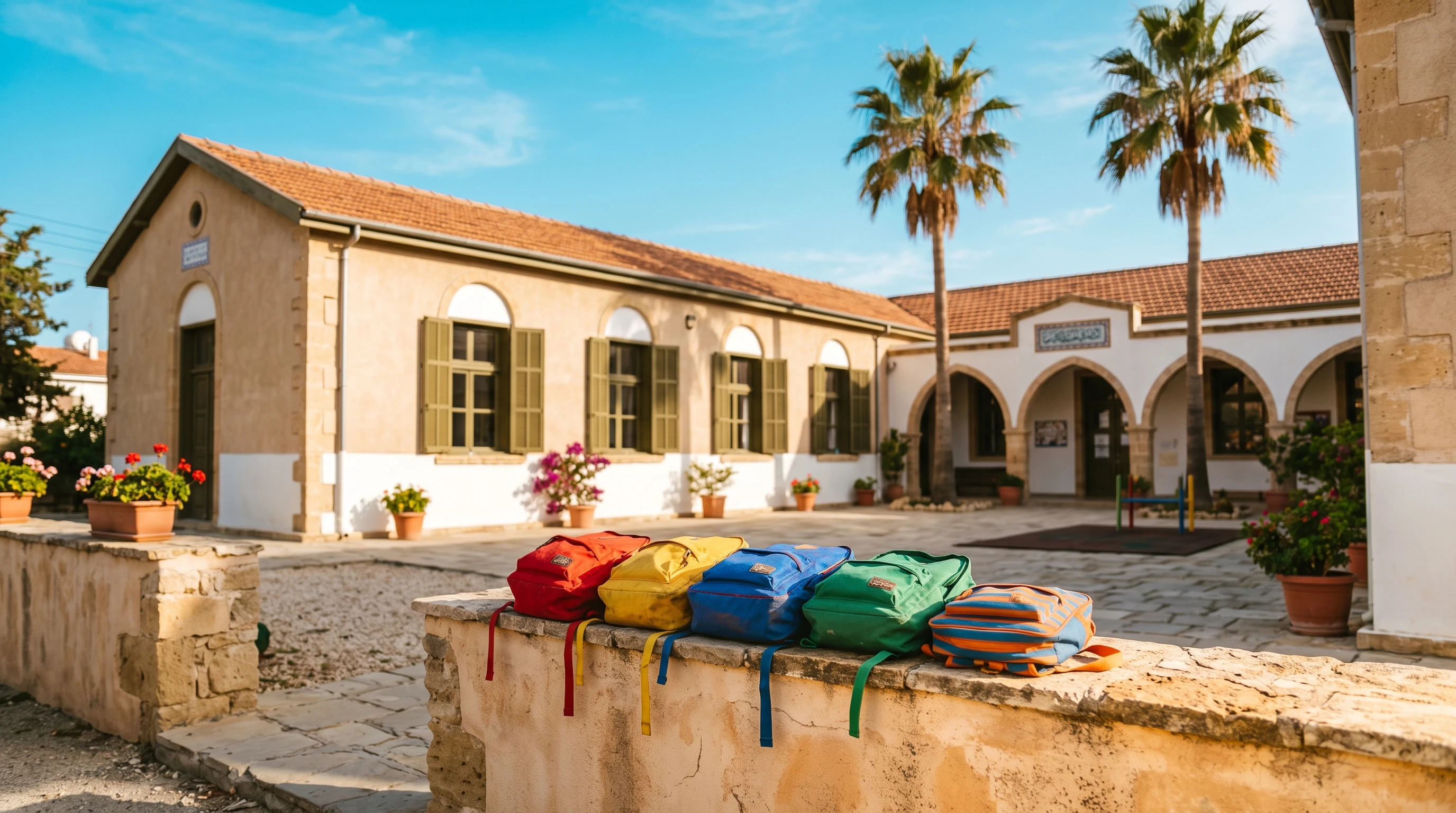
Cyprus has three school tracks: free Greek-medium public schools run by the Ministry of Education, Sport and Youth, fee-paying private schools, and English or IB international schools. All three are open to expat families who are legally resident in the Republic of Cyprus.
Free
Public school tuition
for every legally resident child in Cyprus
5.2%
GDP on education
above the EU average of 4.7% (2023 Eurostat)
€16,000
Top private tuition/yr
upper years at the most expensive schools
4
IB World Schools
in Cyprus; British curriculum is the most widely offered
When I moved to Cyprus in August 2022, my three children landed in three different parts of the school system at once. One was heading into kindergarten, one into school, and one into university. So I didn’t research Cyprus schools once. I made the choice three times over, in the same few weeks, with three different sets of forms.
This guide is about schooling for children. It’s not about driving schools, flight schools, or medical schools, which is what a lot of “schools in Cyprus” searches actually want. If you’re relocating to Cyprus with your family, this is the part I wish someone had walked me through before we arrived.
In this guide:
- Who this is for, and what you’ll need
- How the Cyprus school system works
- Public schools: free, Greek-medium
- Private schools in Cyprus
- International schools and curricula
- Public vs private vs international: how I chose
- What schools in Cyprus cost
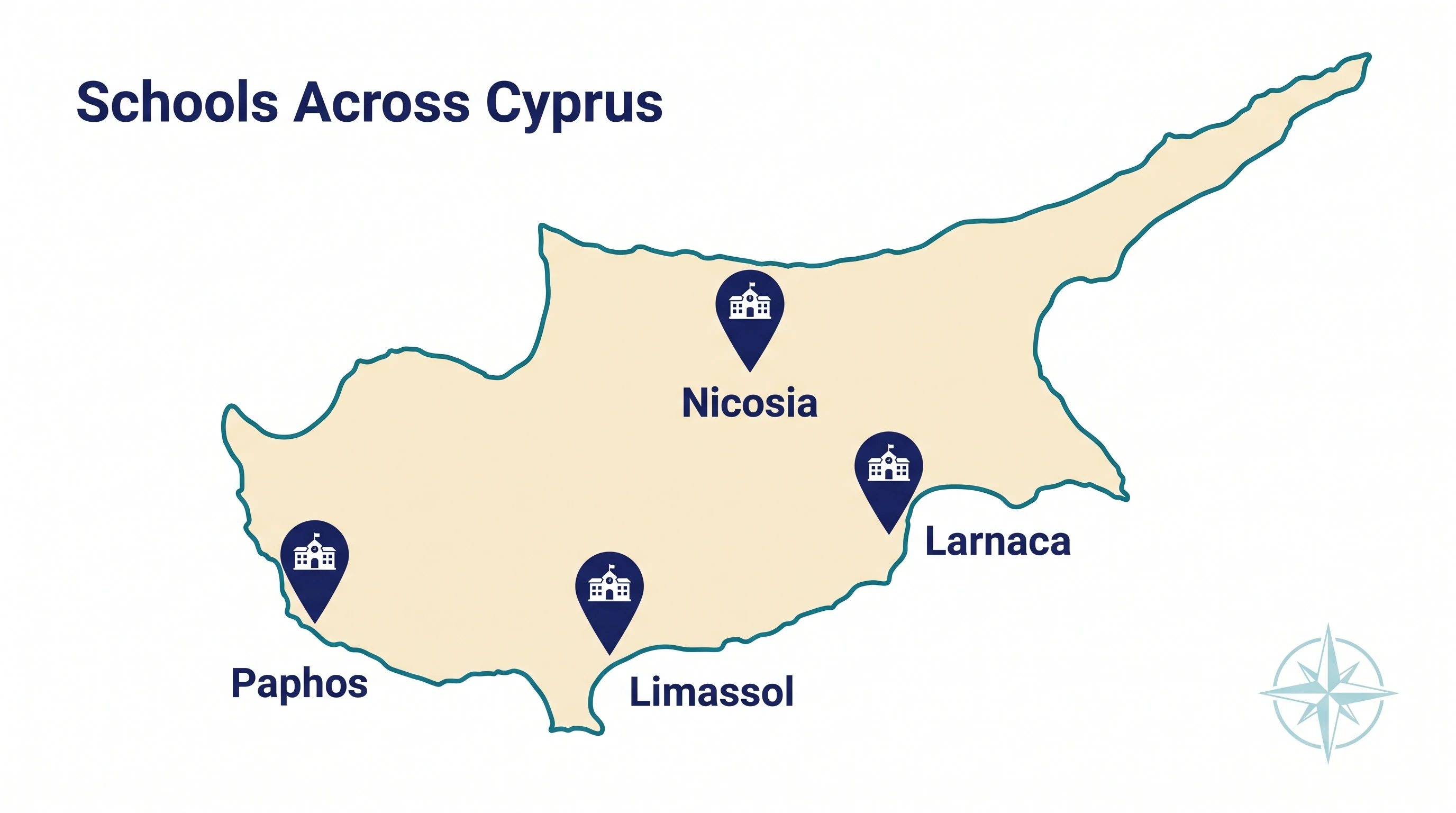
- Schools by city: Limassol, Nicosia, Larnaca, Paphos
- How to enrol your child
- What I’d do differently
- Frequently asked questions
Who this is for, and what you’ll need
Before you start, get this stack ready:
- •Residence: sorted first. Register your stay with the Yellow Slip so you have proof of legal residence.
- •Passports and birth certificates for each child.
- •Vaccination records.
- •Prior-school reports, translated where the school asks for it.
- •Proof of address, which decides your public-school catchment.
- •A decision on language and curriculum, which I’ll help you make below.
I had most of this ready when we arrived. Not all of it. The gaps cost me time, and I’ll come back to that later.
How the Cyprus school system works
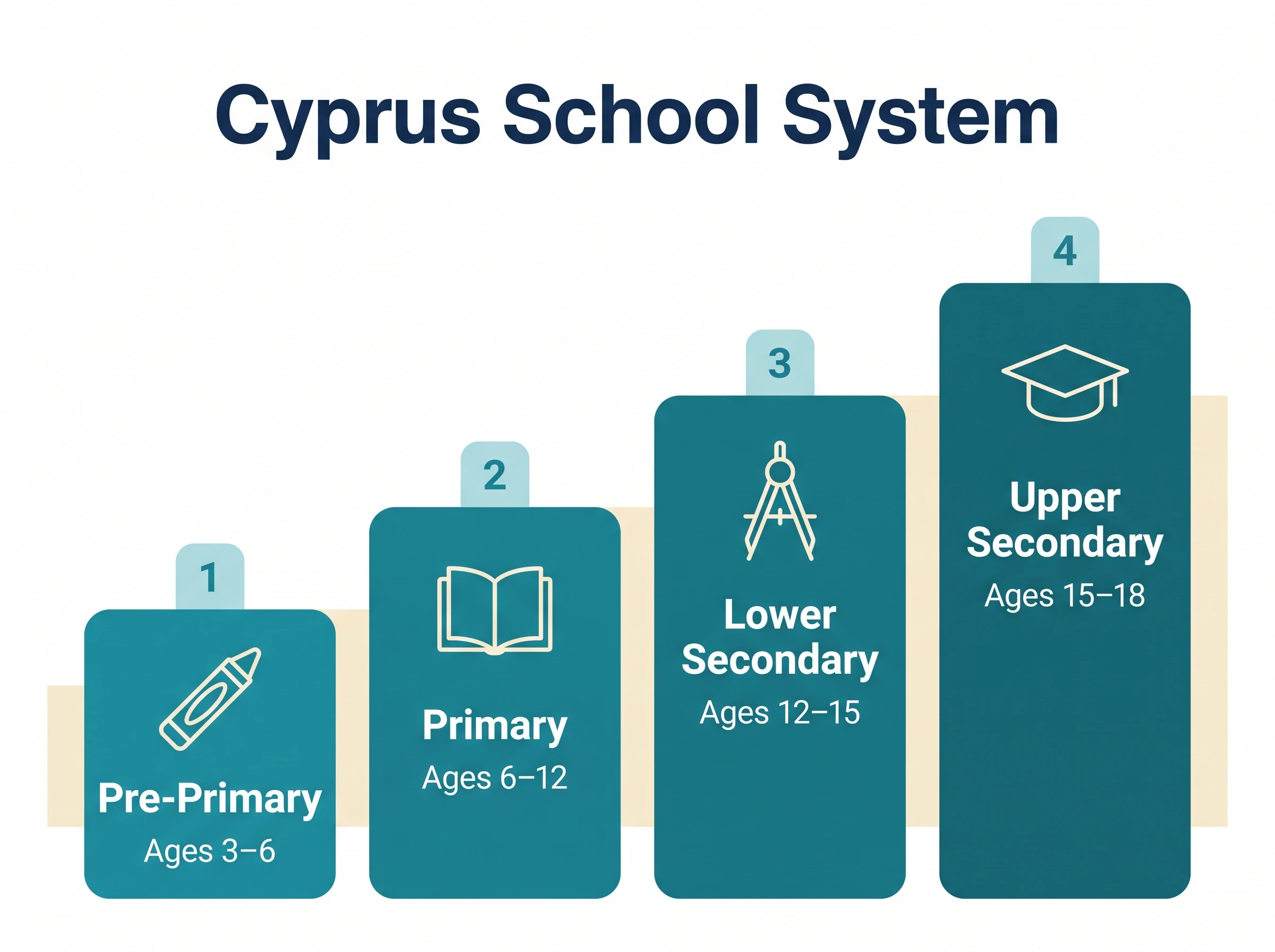
| Stage | Greek name | Ages |
|---|---|---|
| Pre-primary | Nipiagogeio | 3 to 6 |
| Primary | Dimotiko | 6 to 12 |
| Lower secondary | Gymnasio | 12 to 15 |
| Upper secondary | Lykeio (or TESEK vocational) | 15 to 18 |
A few facts worth knowing. Compulsory education runs 10 years and 4 months, from age 4 years 8 months to 15, according to Eurydice, the European Commission’s education network. After Gymnasio, teenagers choose between the academic Lykeio and the technical track. TESEK is Cyprus’s technical and vocational upper-secondary route, mixing general subjects with hands-on trades. It’s a real option, not a fallback.
A public-school day is shorter than many newcomers expect. It runs a morning timetable, roughly 07:45 to early afternoon, with optional all-day programmes that extend it. Private and international hours vary.
What this means
One number reassured me early on: Cyprus spends about 5.2% of national income on education, above the EU average of 4.7% (2023 Eurostat). For a small country, that’s a serious commitment.
Public schools: free, Greek-medium, and what that meant for my kids
Catchment matters more than you’d think. Your home address decides which state school your child attends, so check the zone before you sign a lease. Proof of address goes into the registration pack for exactly this reason.
Here’s the part I weighed hardest. For my youngest, the Greek-medium route was genuinely appealing: free, full immersion, local friendships from day one. At that age children pick up a language faster than their parents can pronounce it. For an older child arriving mid-system, that same immersion is a real wall. There’s a gap between sitting in a Greek classroom and following a maths lesson in Greek, and the gap is wider at 14 than at 5.
The honest trade-off:
- For: no tuition, full cultural integration, your child becomes genuinely bilingual.
- Against: a real language barrier for older arrivals, and the school-leaving certificate (the Apolyterion) may need supplementary exams for some UK or US university entry. Recognition varies by destination country and course, so check the specific university rather than assuming.
What this means
If you’re considering public school, confirm the current enrolment requirements with the Ministry or the school directly. The details shift.
Private schools in Cyprus
Cyprus has a sizeable private sector. The Ministry lists 173 private kindergartens, 31 private primary schools, and 39 private secondary schools. Long-established names you’ll come across include PASCAL, The Grammar School, Foley’s, and The Heritage Private School. I’m listing those as names you’ll see, not as recommendations. The right school depends entirely on your child and your city. You can browse the full inventory on Wikipedia’s list of schools in Cyprus.
International schools and curricula (British, IB, American)
| Curriculum | Leads to | Suits |
|---|---|---|
| British (English national) | IGCSE then A-level | Families wanting a UK university pathway |
| International Baccalaureate (IB) | IB Diploma (PYP/MYP earlier) | Globally mobile families who may move again |
| American | High-school diploma, AP | Families on a US track |
| French / trilingual | National diplomas | Francophone or multilingual families |
Cyprus has four IB World Schools, and the British curriculum is the most widely offered, according to the John Catt international school directory. If you think you’ll relocate again, IB travels the best.
Public vs private vs international: how I chose, three times at once
This is where my situation turned into an accidental experiment. Three children, three stages, one set of decisions, all running in parallel. What I learned is that there isn’t one right answer for a family. There’s a right answer per child.
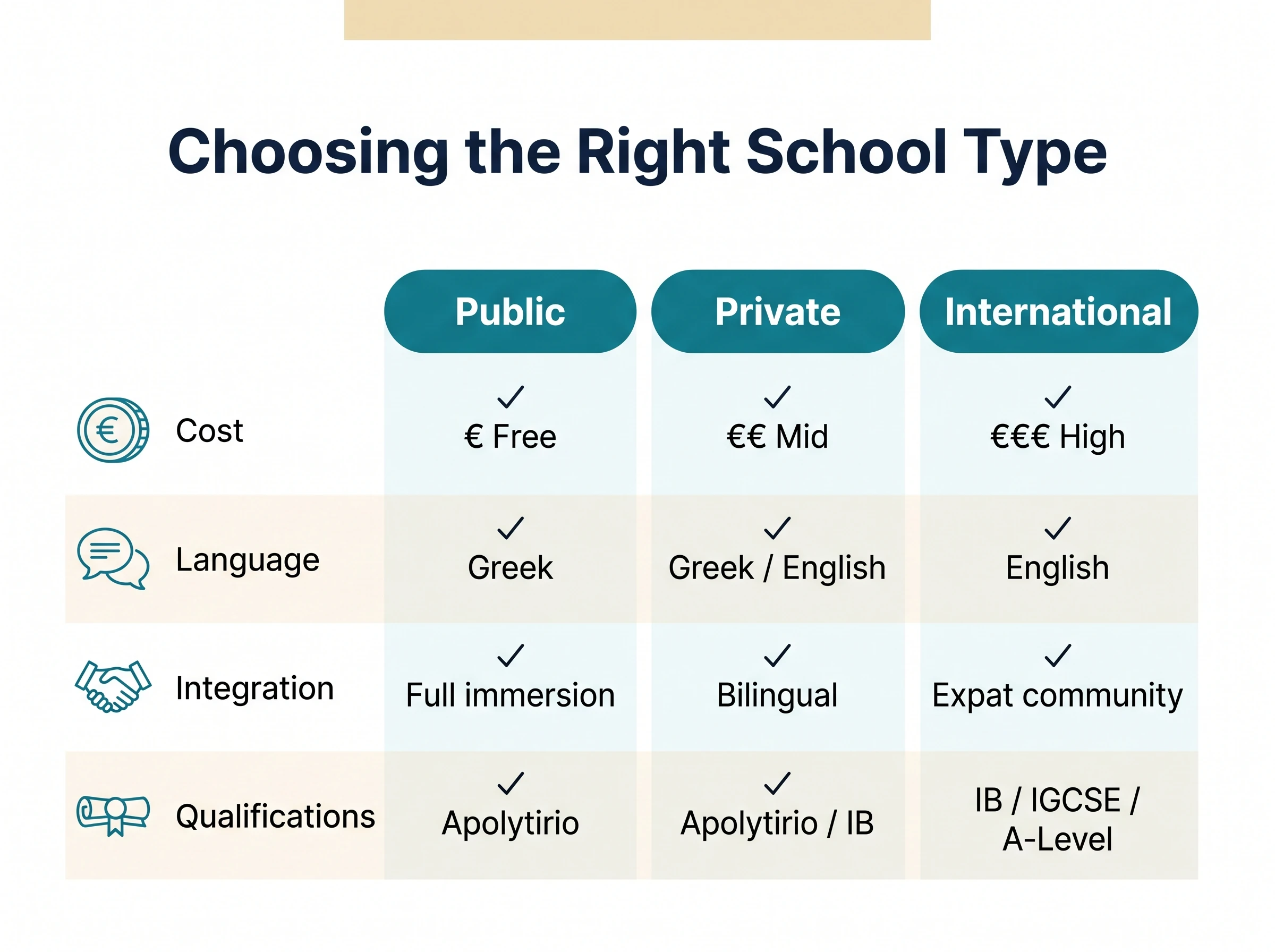
| Public | Private | International | |
|---|---|---|---|
| Cost | Free | Fee-paying | Fee-paying (usually higher) |
| Language | Greek | Mostly English | English / IB |
| Integration | Highest | Medium | Lower (expat-heavy) |
| Qualification portability | Apolyterion (check equivalence) | A-level (strong) | IB (strongest) |
| Best for | Long stay, young child, integration | UK pathway, English-medium | Globally mobile families |
The rough logic I used:
- •Staying long-term and want full integration, with a young child? Public.
- •Want English-medium and a UK pathway? Private or British.
- •Might move countries again? IB international.
- •Greek-Cypriot heritage or a bilingual goal? A bilingual private school.
For my youngest I leaned toward immersion. For the one closer to exam years, I valued an English-medium route and a qualification I actually understood. There’s no “best school” here, only the best fit, and the fit changed with each child. If you’re still mapping the wider move, my moving to Cyprus guide covers the rest of the family logistics.
What schools in Cyprus cost
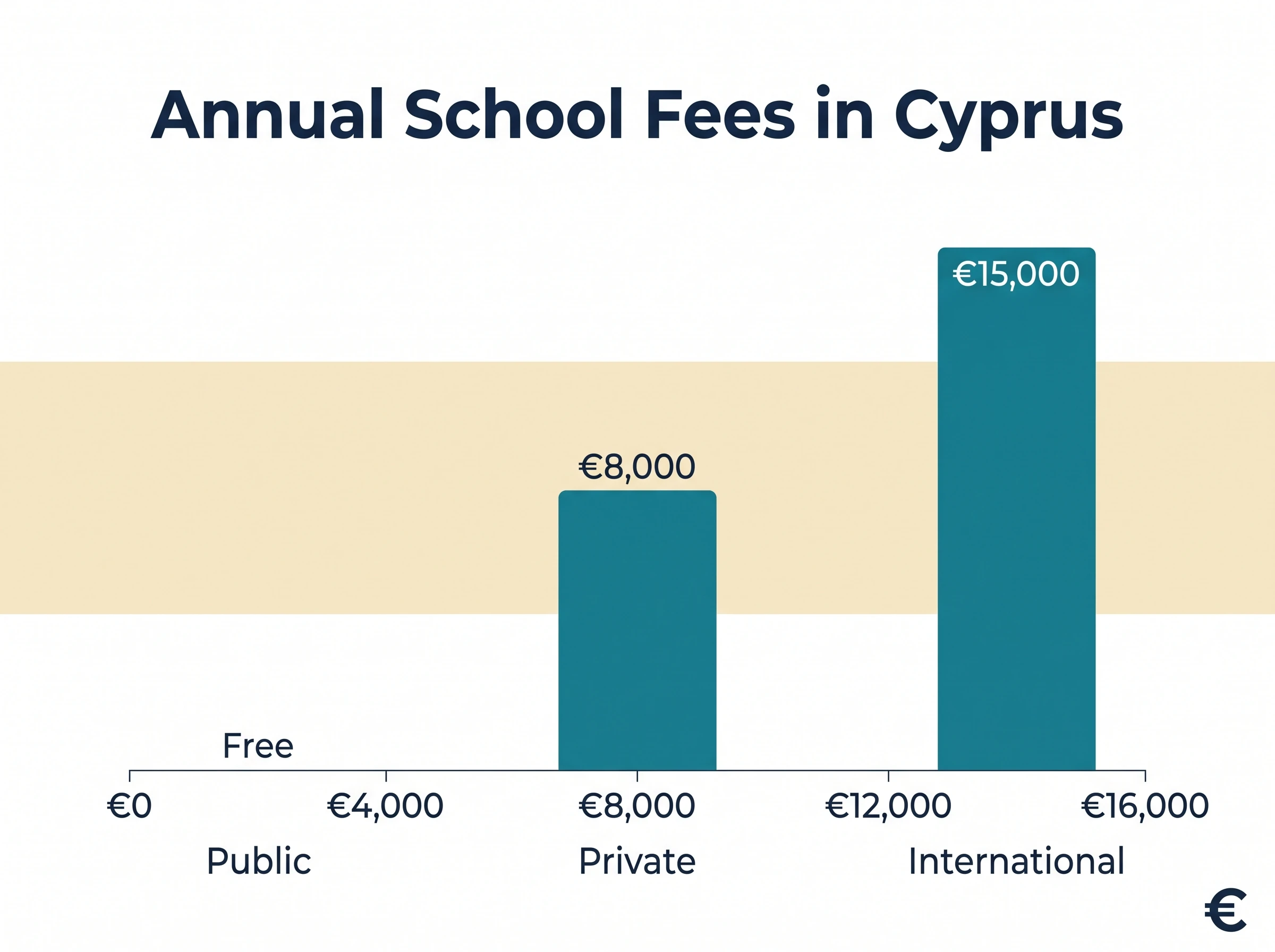
| School type | Typical yearly tuition |
|---|---|
| Public | Free |
| Private / international (lower years) | from about €5,250 |
| Private / international (upper years) | up to about €16,000 |
Figures from international-schools-database. Confirm current fees with each school, because they change yearly and rise with year group.
Private and international tuition typically runs from about €5,250 to €16,000 per year, depending on age, curriculum, and prestige (figures from international-schools-database; confirm current fees with each school, because they change yearly and rise with year group). To anchor that range with real numbers from the same source, the American Academy sits at roughly €5,250 to €9,750 and the Island Private School at roughly €9,650 to €16,000. I’m quoting those as published fee data, not as picks.
Budget for the extras:
- •Registration or enrolment fee.
- •Books and materials.
- •Uniform.
- •Transport (school bus or your own driving).
- •Lunch or canteen.
Fees climb as children move up the years, so a quote for Year 3 won’t match Year 10.
Schools by city: Limassol, Nicosia, Larnaca, Paphos
Here’s the lay of the land across the Greek-side cities. I’m only covering the Republic of Cyprus, not the occupied north, for the title-deed and legal-recognition reasons that apply to everything up there.
Private schools in Limassol
The densest cluster and the highest demand, with a large international and Russian-speaking community. If you want the widest English-medium and IB choice, Limassol leads. Well-known examples include The Grammar School, Foley’s, and Heritage.
Private schools in Nicosia
The capital has some of the oldest and most established schools, including The English School and The Falcon School, plus The American International School in Cyprus (AISC). Strong for families wanting an academic, settled environment.
Schools in Paphos
A smaller but solid set, anchored by The International School of Paphos. Good for families wanting a quieter base on the west coast.
Schools in Larnaca
The smallest of the four clusters, but it has private and international options and sits handy for families near the airport. Worth a look if you’re settling on the southeast coast.
You can cross-check named schools by city on Wikipedia and the John Catt directory.
How to enrol your child, and what our first year was really like
- 1Sort residence first. Register your stay so you have proof of legal residence. My Yellow Slip guide walks through it.
- 2For public school: apply to your catchment school through the local school office, with passport, proof of residence, vaccination records, and prior-school reports.
- 3For private or international: apply directly to the school, often with an assessment, and do it early. Popular intakes fill and close well before the term starts.
- 4Know the calendar: the school year runs roughly early September to late June. Exact term and holiday dates change each year, so confirm the current calendar and enrolment windows on the Ministry of Education site before you plan around them.
Now the real version. Doing three enrolments at once taught me things no checklist did. The paperwork stacks up fast when you multiply it by three children, and document translation took longer than I’d budgeted for. The private and international intakes closed earlier than I expected, so the timing ran tighter than the public route. And settling three kids in at three different stages, kindergarten, school, and university, meant three completely different kinds of first-day nerves. Theirs and mine.
It worked out. But it would have been calmer if I’d started the private applications and the translations a couple of months sooner. If you need to register in person, your local immigration office is part of that early admin too. Always confirm the current document list with the school or the Ministry, since requirements get updated.
What I’d do differently
- Start private applications too early rather than too late. I cut it fine. The good places close intake months ahead.
- Budget weeks, not days, for document translation. Official translations sit in a queue.
- Don’t assume the Apolyterion maps one-to-one onto a UK or US offer. Some universities want extra exams. Check with the university, not a forum.
- Check the catchment before you sign a lease. Your address picks your state school, and you can’t easily undo a signed rental.
Choosing schools for three children at three stages felt enormous at the time. With the sequence straight, it turned into one of the more manageable parts of the move. Sort the residence and the paperwork early, pick the fit child by child instead of chasing a “best” school, and the rest follows. If you’re still mapping the bigger picture, my moving to Cyprus guide is the place to start.
Frequently asked questions
Does Cyprus have English schools?
Is school free in Cyprus?
What is the school system in Cyprus?
When does the school year start in Cyprus?
Is the Cyprus Apolyterion recognised abroad?
How long is a school day in Cyprus?
Which city has the most international schools?
Does public-school placement depend on my address?
I’m Volha. I moved to Cyprus in August 2022 with my husband and three children, who are spread across kindergarten, school, and university here, so I’ve worked through most of the Cyprus education system as a newcomer parent. This is general information from my own experience, not formal advice. Schooling rules and fees change, so confirm the current details with the Ministry of Education or the school before you commit.
Last updated: 29 June 2026.
Not sure you have every document?
Free two-minute checklist: the Migration Department's list for your exact permit, with forms and sources, reviewed by a Cyprus advocate.
Build my free checklistRelated guides
- Moving to Cyprus: newcomer guide
- Yellow Slip (MEU1) for EU citizens
- Immigration offices in Cyprus
- Cost of living in Cyprus
- Healthcare and GeSY
Where you are in the settling-in journey