
Yellow Slip Cyprus (MEU1): The Complete Guide for EU Citizens
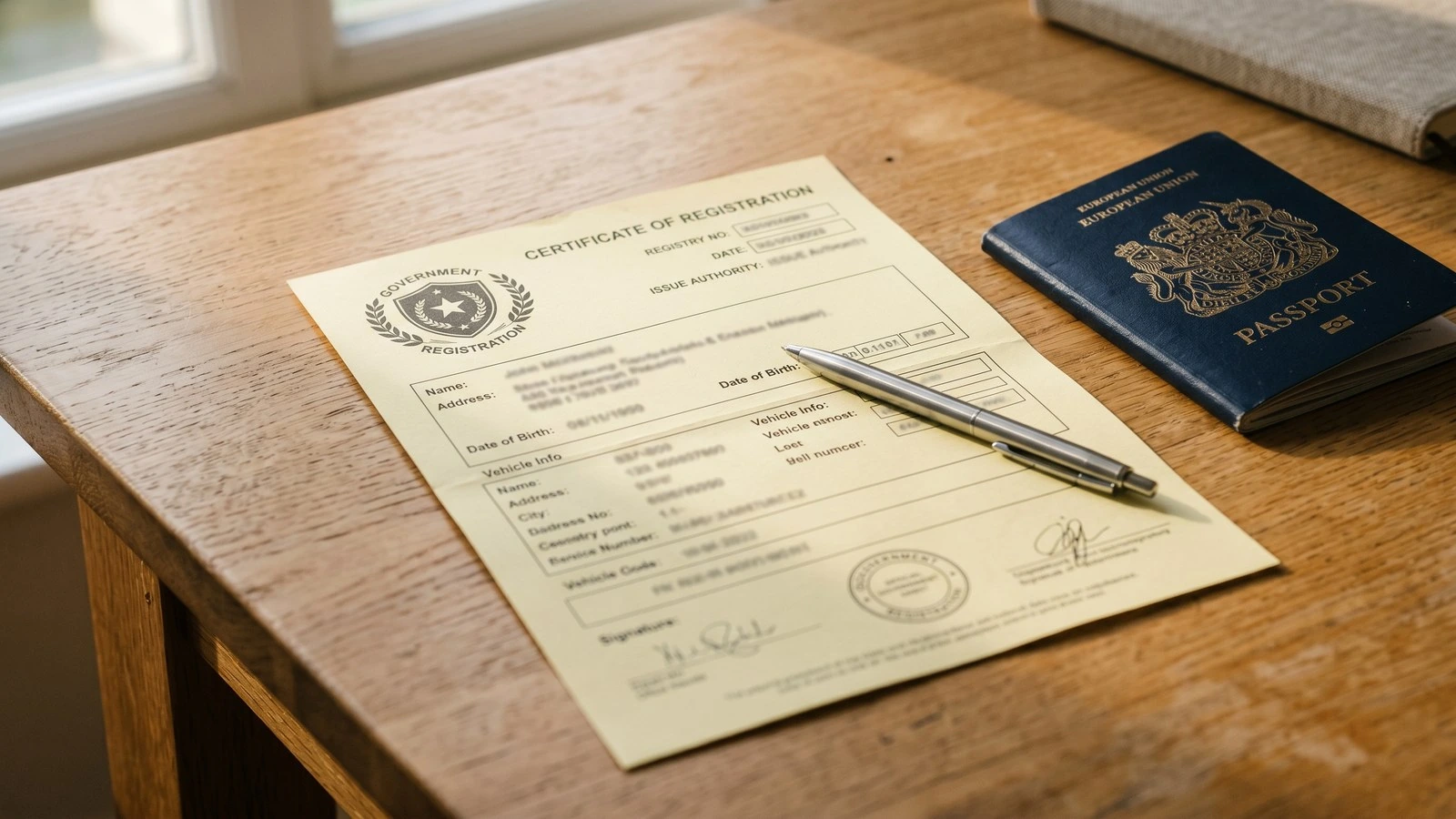
The Yellow Slip is the everyday name for the MEU1 Registration Certificate. An EU, EEA or Swiss citizen registers for it when staying in Cyprus longer than three months. It confirms a right you already hold under EU free movement, so it is not a visa and not a work permit. The government fee is just €20 per person, and once issued it does not expire.
I am Harris Koufettas, an advocate of the Cyprus Bar Association, and I handle immigration matters for people moving here. This is the guide I give clients who want to understand the Yellow Slip before they decide whether to do it themselves. It is general information, not legal advice, and only the authorities decide any individual case.
In this guide:
- What is the Yellow Slip (MEU1)?
- MEU1, MEU2, MEU3: which form is the Yellow Slip?
- Who needs a Yellow Slip in Cyprus?
- What documents do you need?
- How to apply (step by step)
- How much does the Yellow Slip cost?
- Yellow Slip vs Pink Slip vs MEU2
- Does the Yellow Slip expire?
- What can you do with a Yellow Slip?
- The Yellow Slip after Brexit (UK nationals)
- Common mistakes that get a Yellow Slip rejected
- Frequently asked questions
What is the Yellow Slip (MEU1) in Cyprus?
Answer
The legal basis sits in EU law and its Cyprus transposition. Free movement comes from EU Directive 2004/38/EC, and Cyprus brought that into national law through Law 7(I)/2007. The registration itself runs through the Migration Department, renamed from the Civil Registry and Migration Department in 2024 and still called the CRMD by most people. The official EU mobility portal for Cyprus, EURES Cyprus, sets out the procedure for Union citizens.
MEU1, MEU2, MEU3: which form is the Yellow Slip?
Answer
| Form | Who it is for | Validity |
|---|---|---|
| MEU1 (the Yellow Slip) | EU, EEA or Swiss citizen, plus their EU-citizen family | Effectively lifetime, no renewal |
| MEU2 | A non-EU family member of an EU citizen | 5 years, renewable |
| MEU3 | An EU citizen after 5 years of continuous legal residence | Permanent residence |
So the MEU1 is the registration certificate for the EU citizen. A non-EU spouse or child of that EU citizen registers on the MEU2 residence card instead. After five years here, an EU citizen can move up to the MEU3 permanent residence certificate. District immigration offices sometimes refer to all of these by their form codes rather than colours, so do not be thrown if a clerk asks about your “MEU1”. The procedure and forms are published by EURES Cyprus and the Deputy Ministry of Migration and International Protection.
Who needs a Yellow Slip in Cyprus?
Answer
Who does not use the Yellow Slip matters just as much, because a lot of people search for the wrong document:
- Non-EU nationals (third-country nationals) register through the Pink Slip, the temporary residence permit, not the Yellow Slip.
- A non-EU family member of an EU citizen registers on the MEU2 residence card, not the MEU1. That route has its own MEU2 guide.
- UK nationals who arrived from 1 January 2021 are third-country nationals after Brexit and follow the Pink Slip or Category F route. UK nationals already resident before that date are covered separately, in the Brexit section below.
The trigger to remember is timing. You should register within four months of arriving, a deadline set out by EURES Cyprus and the Deputy Ministry of Migration and International Protection. Count from your arrival date, not your appointment date. That is the part applicants most often get wrong.
What documents do you need for the Yellow Slip?
Answer
The core documents are:
- The completed MEU1 application form.
- Your valid passport or national ID card, plus copies.
- Two recent passport photographs (35 by 40 mm, white background).
- Proof of address.
- The €20 government fee.
For proof of address the government rule is specific: a rental agreement of at least one year, stamped at the Tax Office and certified by a Muhtar (the local Certifying Officer). A casual tenancy printout will not clear the counter.
The category-specific extras are:
- Employed: confirmation of employment from your employer (the employer-completed Part III / Section III of the form).
- Self-employed: proof of registration with the Social Insurance Services.
- Student: proof of enrolment, comprehensive health insurance, and a declaration of sufficient resources.
- Self-sufficient or retired: proof of income or deposits, plus comprehensive health insurance.
Two figures here come from law-firm practice rather than the government pages, so I phrase them conservatively. On income, the government text asks only for “sufficient resources”; law firms commonly cite around €4,613 a year per person as a working benchmark. On health cover, the government simply requires comprehensive health insurance in the Republic, and law firms commonly cite cover of at least €30,000. My full guide to medical insurance for your residence permit explains the standardised Plan A policy and how it meets this rule. If you need that cover, a comprehensive policy written for MEU1 applicants from DigiCare, the licensed Cyprus insurance agency that owns this site, is one way to meet the requirement. Treat both figures as a planning guide and confirm your own case.
Finally, any foreign document that is not already in Greek or English must be officially translated, and foreign public documents generally need an apostille. The translation and certification rules are published by the Deputy Ministry of Migration and International Protection. The full required-document list, including the photo specification and the rental-certificate rule, is set out by the Department of Labour Relations (MLSI) and by EURES Cyprus.
How to apply for the Yellow Slip (step by step)
Answer
- 1Gather your documents. Allow a week or two, and longer if anything needs an apostille or a certified translation, which can take a few weeks on their own.
- 2Book an appointment at the immigration unit in the district where you live. Walk-ins are generally not accepted, and slots fill weeks ahead in the peak March to May period.
- 3Attend in person to submit the file and give your details.
- 4Pay the €20 fee per person at the office.
- 5Receive the certificate, typically the same day to about a month for the MEU1.
You apply at the immigration unit for the district where you live, so Nicosia, Limassol, Larnaca, Paphos or Famagusta. For the Famagusta district, the unit sits in Paralimni, which is where you submit. The Immigration Offices in Cyprus hub maps each district to the right office, with phones, hours and what to bring. I deliberately do not print street addresses here, because they differ between sources and move. Use the official Migration Department directory for the current office, and the procedure as published by EURES Cyprus.
Want help applying?
If you would rather not handle the appointment booking and the paperwork yourself, New to Cyprus runs an AI-checked, lawyer-reviewed Yellow Slip service that checks your documents before you file. It is optional. The steps above are all you strictly need.
See Yellow Slip service →How much does the Yellow Slip cost?
Answer
Some applicants believe it costs far more because the fee gets bundled with the cost of preparing documents. Those ancillary costs are separate and optional depending on your paperwork:
| Item | Typical cost |
|---|---|
| Government fee (per person) | €20 |
| Certified translation (per document) | around €30 to €80 |
| Apostille (per document) | around €10 to €50 |
| Private health insurance (if required) | around €120 to €200 |
I include this breakdown for a reason. Transparency is the honest difference between doing it yourself and paying an agency that quotes €300 or more, by folding the €20 statutory fee into an opaque bundle. The ancillary ranges above are industry figures. The €20 is the official government fee.
Yellow Slip vs Pink Slip vs MEU2: what is the difference?
Answer
| Document | Who it is for | Validity | Renewal |
|---|---|---|---|
| Yellow Slip (MEU1) | EU, EEA or Swiss citizens | Effectively lifetime | None |
| MEU2 residence card | Non-EU family of an EU citizen | 5 years | Renewable |
| Pink Slip (TRP) | Non-EU (third-country) nationals | About 1 year | Annual |
Because it rests on EU free movement, the Yellow Slip is also issued faster than the Pink Slip, which involves a fuller immigration assessment. If you are a non-EU national, the route you want is the Pink Slip, covered in its own New to Cyprus guide. The audience definitions here follow EURES Cyprus and the Deputy Ministry of Migration and International Protection.
Does the Yellow Slip expire? Validity and “renewal”
Answer
Two contrasts are worth keeping in mind. A non-EU family member’s MEU2 card is valid for five years and is renewable, which is different from your MEU1. And after five years of continuous legal residence, you as an EU citizen can apply for the MEU3 permanent residence certificate. The lifetime nature of the MEU1 is consistent with how EURES Cyprus and the Deputy Ministry of Migration and International Protection treat the registration certificate.
What can you do with a Yellow Slip? (Benefits)
Answer
With it you can:
- Live and work in Cyprus without a separate work permit.
- Open a Cyprus bank account.
- Register or import a vehicle. Yes, you do need your Yellow Slip to register a car at the Road Transport Department, which is the answer to a common question.
- Enrol in GeSY, the national health system, once you also have social-insurance status.
- Obtain a Social Insurance Number.
- Access education at resident rates.
It is also the first step toward becoming a tax resident. That is a separate test with its own rules, and I will not fold it in here. For the next moves, the New to Cyprus guides on GeSY, banking and the wider moving-to-Cyprus process pick up where this one ends.
The Yellow Slip after Brexit (UK nationals)
Answer
If you were legally resident before 31 December 2020, you hold or convert to the relevant UK Withdrawal-Agreement certificate, a position set out by the Deputy Ministry of Migration and International Protection. If you arrived from 1 January 2021, you cannot obtain a new Yellow Slip. You register through the Pink Slip or the Category F route instead, exactly as someone moving from the United States or Canada would. You may see references to specific conversion deadlines for older paper certificates. Treat any such date as something to confirm directly with the CRMD, because the published guidance is the only reliable source on timing.
Common mistakes that delay or get a Yellow Slip rejected
Answer
- Submitting a fintech bank statement (Revolut, Wise, N26) instead of a traditional bank statement, which offices frequently will not accept as proof of funds.
- A rental agreement that is not Tax-stamped and Muhtar-certified, the single most common proof-of-address failure.
- Foreign documents without an apostille or a certified Greek or English translation.
- Laminating the certificate, which can invalidate official Cyprus documents.
- Expired or near-expiry documents; keep validity comfortably beyond your appointment date.
- Booking too late to meet the four-month deadline, especially in the March to May peak.
Every one of these traces back to the document checklist above, so the fix is simply to prepare carefully. The required-document and certification rules are published by the Department of Labour Relations (MLSI) and the Deputy Ministry of Migration and International Protection.
Frequently asked questions
What is the difference between a Pink Slip and a Yellow Slip in Cyprus?
What documents do you need for the Yellow Slip in Cyprus?
How much does a Yellow Slip cost in Cyprus?
How long does it take to get a Yellow Slip?
Do you need a Yellow Slip to buy a car in Cyprus?
Does the Yellow Slip expire or need renewing?
Can I travel on my Yellow Slip?
What happens if I miss the four-month deadline?

Harris Koufettas
advocate · Cyprus Bar R.N.4466
Rather not handle the CRMD paperwork yourself?
Free AI document check, flat-fee help, optional Koufettas Law review.
See Yellow Slip service