
Driving in Cyprus: What I Wish Someone Had Told Me Before My First Drive
 By Volha Bendzik, relocation editorReviewed by Harris Koufettas, advocate, Cyprus Bar R.N.44667 July 2026 · 9 min read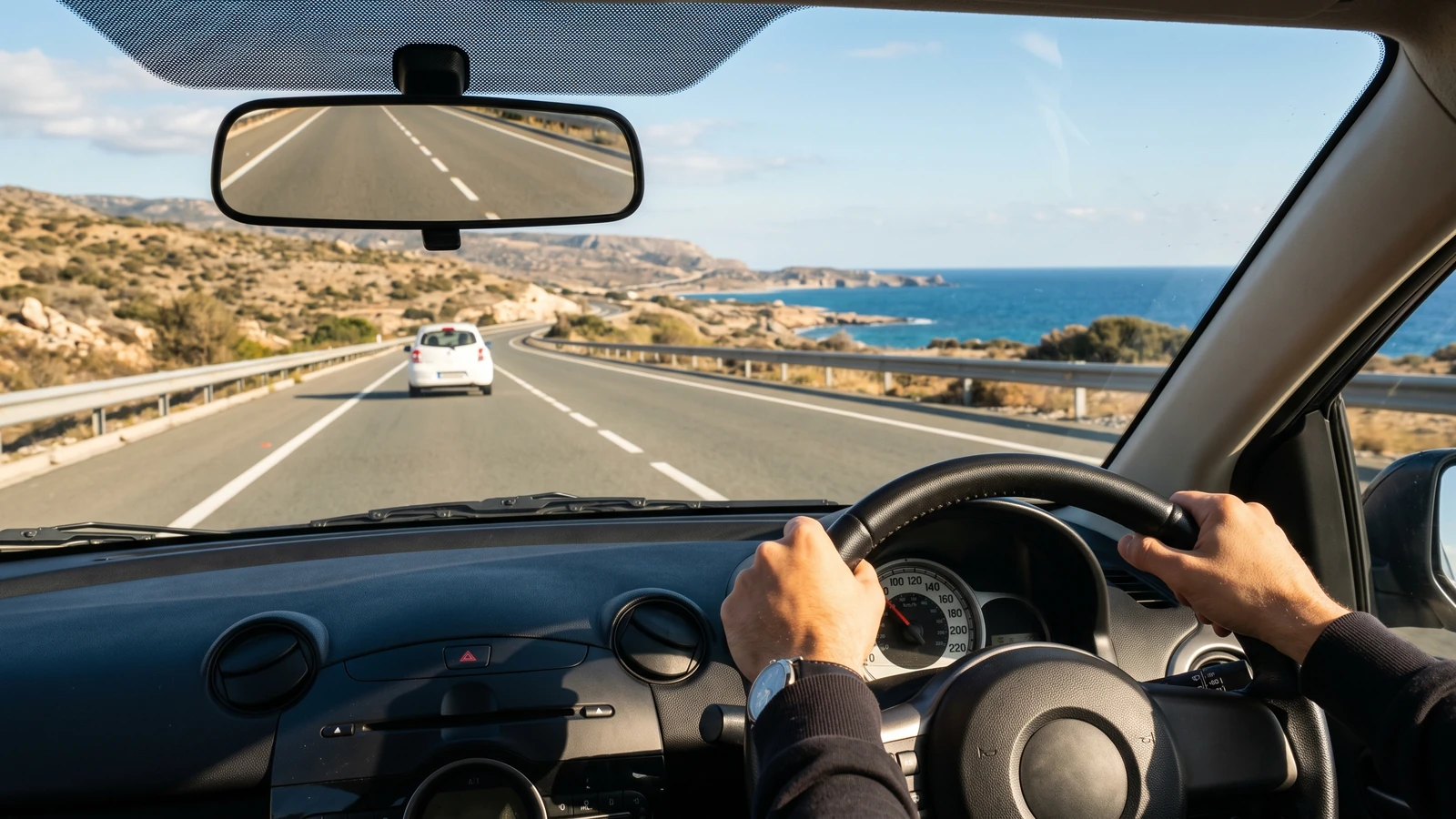
Cyprus drives on the left, and if you're coming from continental Europe that's the single biggest adjustment. The hard part isn't the car or the road; it's retraining every instinct about which way to look. I'd give yourself a day or two of slow roundabouts before it feels normal.
This guide covers what actually matters when you start driving here: whether your licence is valid, the rules that differ from home, what those red number plates mean, and the one real trap: insurance at the Green Line. If you're deciding whether to rent, my car rental in Cyprus guide covers costs and how to avoid the airport-desk surprises.
One scope note before we start: this page covers the rules of the road and hire-car basics. Owning, registering and insuring your own car is its own process, and that lives in the moving to Cyprus guide.
In this guide
Which side of the road does Cyprus drive on?
Answer
If you learned to drive in the UK, Ireland, Malta, Australia or Japan, you'll feel at home immediately. If you learned on the right, give yourself a quiet first day. The moments that catch people out aren't the motorways. They're the empty side street at 7 a.m. when muscle memory takes over, and the first look-left-look-right at a junction.
What this means for you
Do you actually need a car in Cyprus?
Answer
We managed our first weeks without a car, and it worked, barely, because we stayed central. School runs, IKEA-style shopping trips, the immigration office with three kids in tow: all of it got dramatically easier the day we had our own wheels. Most newcomer families I know rented monthly at first, then bought.
If you're a visitor staying in one resort, you can skip the car and book taxis and day tours. Everyone else: budget for one. The rental guide has the long-term and monthly options newcomers actually use.
Is your driving licence valid in Cyprus?
Answer
- EU/EEA licence: drive as long as it's valid. After you settle you can voluntarily exchange it for a Cypriot one, but you don't have to.
- UK and other listed countries: valid for visits; once you become a resident there's a window to exchange it for a Cypriot licence without a test. Check the current list and window with the Department of Road Transport before you rely on it.
- Everyone else: bring an International Driving Permit with your national licence, and expect to sit the Cypriot test if you move here long-term.
- Rental desks add their own rules: most want the licence held for at least a year, and drivers under 25 often pay a young-driver surcharge. That's company policy, not law.
One practical note: if your licence isn't printed in the Latin alphabet, get the IDP even where it's technically optional. It saves arguments at rental desks and police stops alike.
The road rules that differ from home
Most of the rulebook is standard European. These are the numbers and habits that actually differ, verified against the official sources on 7 July 2026:
| Rule | Cyprus | Worth knowing |
|---|---|---|
| Driving side | Left | Right-hand-drive cars; clockwise roundabouts |
| Motorway speed limit | 100 km/h (min. 65 km/h) | Cameras are increasingly common |
| Open roads | 80 km/h | Unless signed lower |
| Built-up areas | 50 km/h | 30 km/h zones exist near schools |
| Alcohol limit | 22 µg/100 ml breath (50 mg/100 ml blood) | Stricter than England's 35 µg: treat it as don't drink and drive |
| Seat belts | Mandatory, front and rear | Under 135 cm: child seat. Up to 150 cm: at least a booster |
| Mobile phones | Handheld use banned | Hands-free only; fines apply |
| Road tolls | None | Every motorway in Cyprus is free |
Limits change by law; check before you rely on them.
Sources for the figures above: the EU's official road rules for Cyprus page and the Cyprus Police co-authored guide to driving in Cyprus (PDF), both checked on 7 July 2026.
- Look right first at roundabouts; the traffic on the roundabout has priority.
- Keep left on the motorway except to overtake; passing on the left is against the rules of the road.
- Carry your licence whenever you drive: police can ask for it at any stop.
- Don't turn on a red light, ever; there's no left-on-red rule in Cyprus (the Cyprus Police publish the current fines).
Renting a car: the short version
Hire cars in Cyprus wear red number plates, which is useful in practice: locals recognise a visitor and mostly give you an extra beat at junctions. The rental market is busy, seasonal and full of small print: deposits, excess insurance, fuel policies and young-driver fees vary a lot between desks.
The full rental guide
Costs by season, airport pickup at Larnaca and Paphos, what excess and CDW actually cover, monthly rentals for newcomers, and the questions to ask before you sign.
Read: Renting a car in CyprusThe Green Line and the north: the insurance trap
Answer
This is the one place where a relaxed holiday decision can turn into an uninsured accident in territory where your rental company won't help you. Read your rental agreement before you plan a trip north, and assume the answer is no unless it says otherwise in writing. This site covers the Republic of Cyprus, the Greek side, only; that's where EU law, EU consumer protection and your Republic-issued insurance actually operate.
Fuel, tolls and mountain winters
- No tolls: the whole motorway network (A1 to A6) is free. Fuel is the only road cost.
- Petrol stations: staffed by day in towns; at night and in villages you'll use the self-service card machines at the pump. They take bank cards but the interface can be Greek-first, so look for the language button.
- Summer: cars parked in the sun become ovens. A windscreen shade isn't cosmetic here; steering wheels get too hot to hold in August.
- Troodos in winter: the mountains get real snow. Police can require snow chains on the summit roads, and rental cars usually aren't equipped. If you're planning a January trip to the ski area, say so at the rental desk.
- Car insurance: third-party cover is the legal minimum for any car you own. Once you settle and buy a car, a Cyprus policy from DigiCare (this site's parent company) is one option for newcomer-friendly cover.
Frequently asked questions
Is driving in Cyprus the same as in the UK?
Do I need an International Driving Permit in Cyprus?
Are hire cars in Cyprus automatic or manual?
Why do some cars in Cyprus have red number plates?
Are there road tolls in Cyprus?
Can I drive a rental car to North Cyprus?
This guide is general information, not legal advice. Traffic law, licence-recognition rules and fines change; the Republic of Cyprus portal (gov.cy) and the Cyprus Police publish the current rules. Facts on this page were verified on 7 July 2026 and reviewed by Harris Koufettas, advocate of the Cyprus Bar (R.N.4466).
Spotted something out of date? Report it via the contact page and it gets corrected.
Volha Bendzik
Relocation & living editor
Volha moved to Cyprus with her family in 2022 and has been driving here ever since: school runs, mountain trips and all. Legal facts reviewed by Harris Koufettas, advocate, Cyprus Bar R.N.4466.
Deciding whether to rent?
Costs by season, airport pickup, excess insurance explained, and monthly rentals for newcomers.
Car rental in Cyprus